Data Security Posture Management for AI: A CISO Guide
Data security posture management for AI explained for security leaders. Covers data path inventory, retention, masking, egress controls, and more.
By Jonny Freedman, CEO, Agntz
By Jonny Freedman · Published
An agent can look harmless in a design review and still be passing customer records into a third-party model endpoint on every completion. That's the gap most security teams hit first. The database and bucket are mapped, the AI call path is not, and the result is a blind spot in data security posture management for AI that outside-in tooling only sees after data has already moved.
Traditional DSPM is still useful, but it stops too early for agent systems. AI workflows add prompts, responses, embeddings, RAG corpora, model endpoints, vendor hops, and logs that often sit in places nobody labeled as data stores. That's why the right control model starts inside the codebase, builds a capability map before runtime, and then uses that map to decide what must be blocked, redacted, or reviewed.
Practical rule: if an agent can reach a model endpoint, a retriever, or an observability sink, that path needs to be on the posture map before the first production prompt goes out.
Table of Contents
- The Data Path Nobody Puts on a Diagram
- What Data Security Posture Management for AI Covers
- Inventorying the AI Data Surface
- Controls for Data in Motion Through AI Workflows
- Prompt Injection and Indirect Prompt Injection as Data Risks
- Drift Detection and Continuous Assurance on Every Commit
- Mapping Capabilities to Controls and Audit Evidence
- Frequently Asked Questions
- What data path should a CISO lock down first in an AI assessment?
- How can teams continuously scan AI data flows without runtime sensors?
- Which KPI moves first when DSPM for AI is implemented?
- What's the most common unexpected vulnerability in AI data posture reviews?
- Why is prompt injection a data security issue, not just an app bug?
The Data Path Nobody Puts on a Diagram
The first path that usually matters is the one nobody put on the architecture board, agent-to-third-party-model calls. Every completion can carry context, and context can carry regulated data, proprietary code, or customer records into a provider endpoint. That path is often invisible in the places teams already trust, because the database diagram looks clean while the LLM call sits inside application logic, orchestration code, or a tool wrapper.
A source-code-first assessment catches that path earlier than runtime telemetry does. Reading the repository and its dependencies shows which agents can reach which endpoints, what data they can touch, and where credentials travel. Runtime observation only proves that something already happened. It does not tell security what the agent was able to do before the first request left the perimeter. For a practical example of how shadow AI shows up in code, see shadow AI patterns in codebases.
What gets missed first
The usual misses are predictable once the control surface widens beyond the database:
- Transitive vendor calls that send context to a provider the owning team never explicitly approved.
- Prompt and context logs that preserve full completions in observability tools with broader access than the source system.
- Tool bindings that let an agent reach a ticketing system, object store, or internal API without a matching data review.
- Embedding and retrieval paths that move sensitive content into places teams don't think of as storage.
That is why posture management for AI has to ask a harder question than “where is the data.” It has to ask, “what can this agent reach, and what can that reach contain.” The answer drives the control decisions that matter most, especially when regulated data such as PII and PHI can flow into external services without any human noticing in the moment. A code-level capability map also gives GRC and engineering a shared artifact instead of two competing interpretations of the same system.
What Data Security Posture Management for AI Covers
Data Security Posture Management for AI is the continuous discovery, classification, monitoring, and protection of sensitive data as it moves into, through, and out of AI systems. The scope goes beyond classical DSPM because the control surface now includes training datasets, RAG corpora, vector embeddings, prompt logs, response logs, model endpoints, and transitive vendor calls Orca Security's DSPM for AI overview. That matters because once sensitive content is embedded in model weights or passed through inference workflows, recovery gets harder and the downstream exposure is harder to unwind.
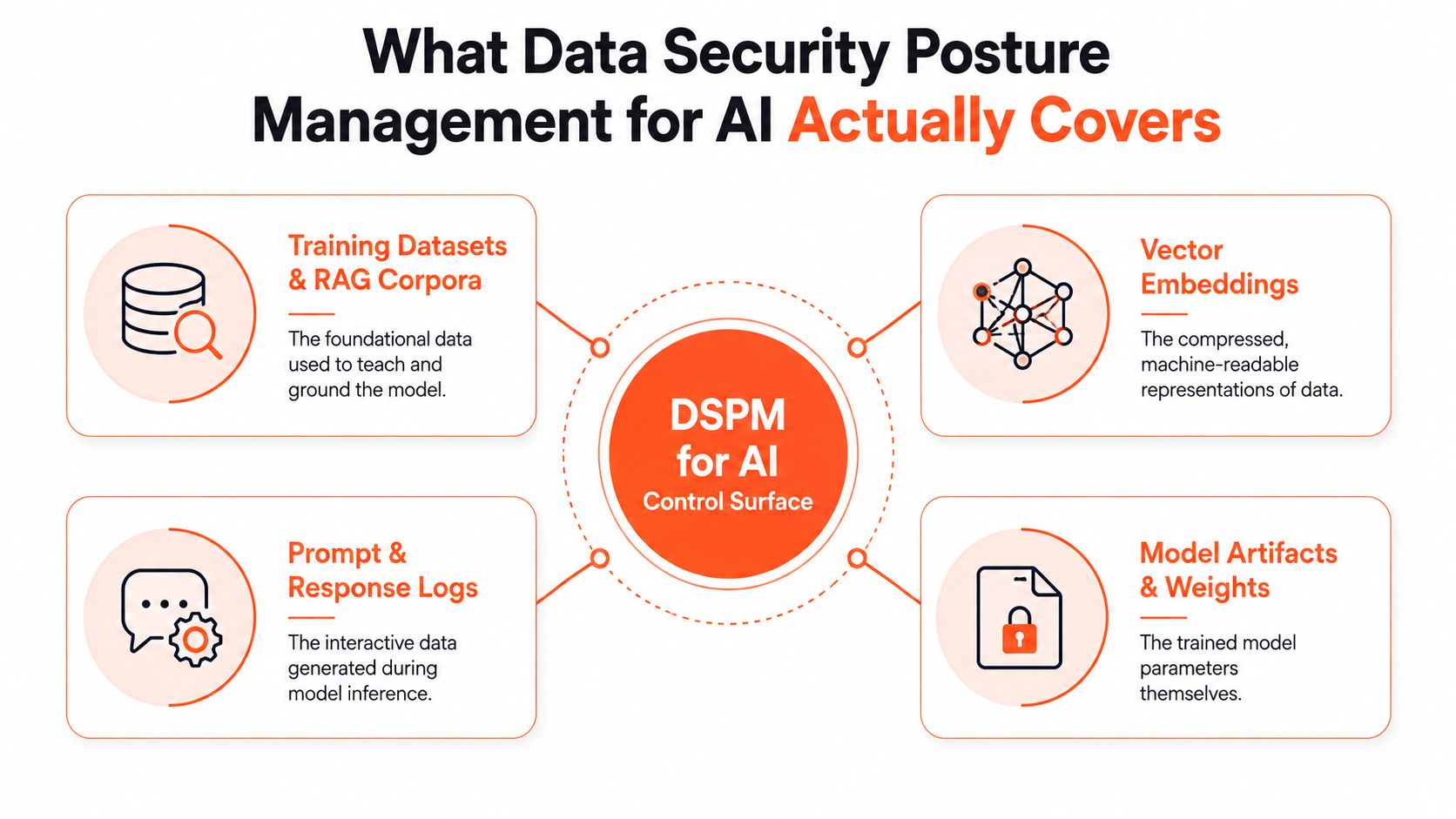
From static storage to AI control surfaces
Classical DSPM focuses on data at rest in databases and object stores. AI changes where the risk sits. A corpus can look clean in storage and still become dangerous when it is chunked for retrieval, embedded for search, or mixed into a prompt that an external model can see. The control point shifts from passive inventory to active governance across training, fine-tuning, and inference paths.
Microsoft's Purview DSPM for AI gives a concrete operating model for that shift. It centers AI activity analytics, ready-to-use DLP policies for prompts, and data risk assessments built for copilots and generative AI apps Microsoft Purview DSPM for AI guidance. That makes the policy layer easier to defend in review, because it is tied to observed AI activity rather than generic data scans alone. A security team can explain the difference in two sentences, which is usually what a stakeholder needs. Classical DSPM tells you where sensitive data sits. DSPM for AI tells you how that data moves through AI systems and what policy actions are available when it does.
Why continuous discovery matters
Periodic scanning plus manual exception handling breaks down quickly in AI environments. Discovery has to stay continuous, and classification needs an AI-readiness dimension so data can be marked safe or unsafe for training, prompting, or retrieval. The source of truth also has to include AI artifacts that do not look like ordinary records, because those are the places teams miss on first review.
Microsoft's material also makes the policy mechanics concrete. It describes AI activity analytics and prompt-focused DLP, while the wider operational pattern is to automate remediation when overpermissioning or risky data movement appears. That is the operational difference leadership usually needs to hear. This is another control layer, and it decides whether an AI system can touch, transform, or leak sensitive data.
Operational takeaway: if a policy cannot reason over prompts, responses, embeddings, and endpoint calls together, it is not covering the AI surface. It is covering a slice of it.
Inventorying the AI Data Surface
Inventory is not a list of databases with an AI label on top. It's a capability map. The distinction matters because a single agent can span object storage, a vector database, an observability platform, and a third-party model endpoint in one request chain. If the assessment only records the obvious data store, the blast radius stays undocumented and the response plan is weaker than it looks on paper.
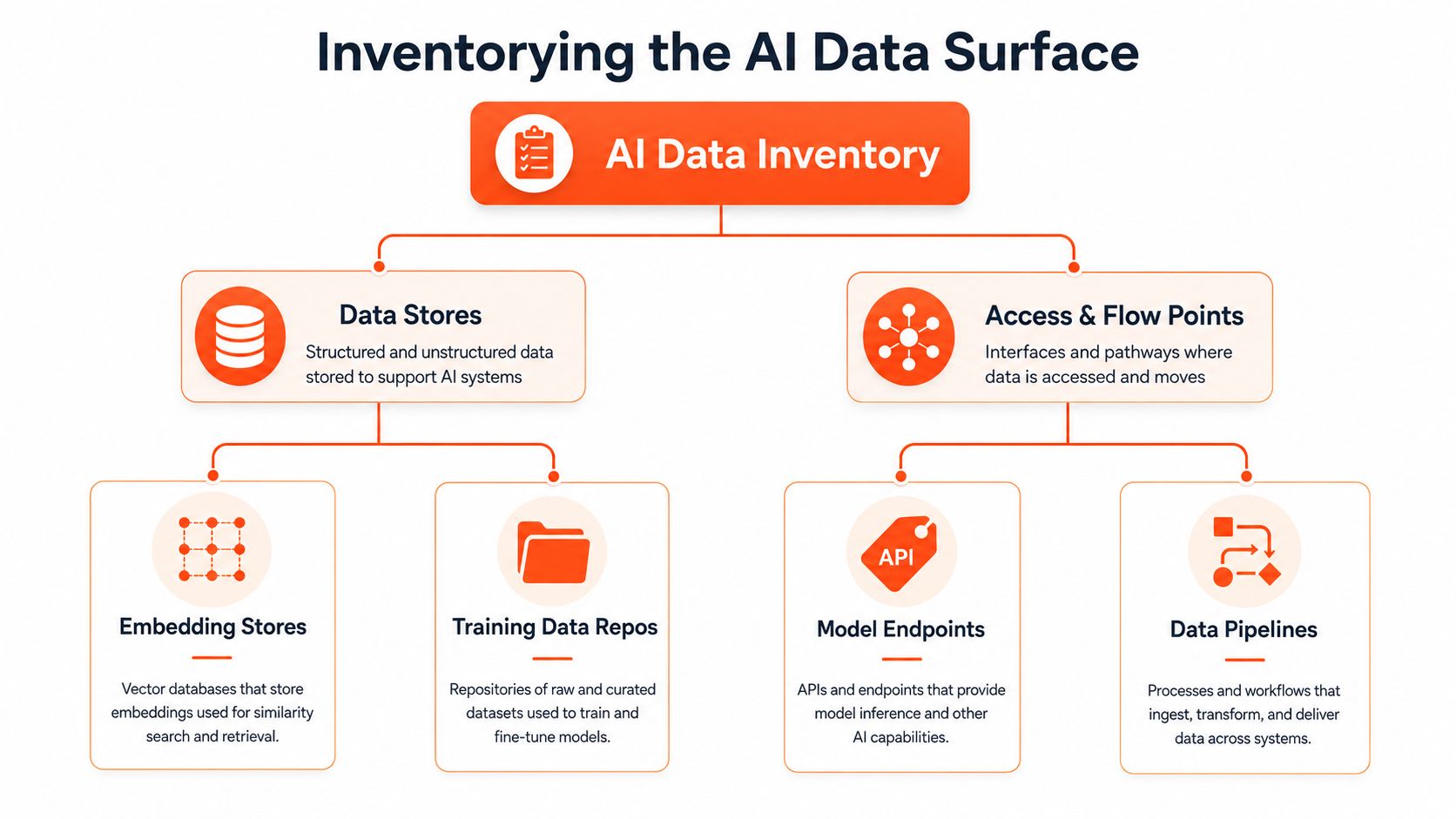
The objects that belong on the first worksheet
The first worksheet needs to capture object types, not just systems names:
| Object type | Why it matters | Common storage primitive |
|---|---|---|
| Model endpoints | They define where context and outputs leave the app boundary | API gateway, service endpoint |
| Embedding stores | They can retain sensitive traces in machine-readable form | Vector database |
| RAG indices | They determine what retrieved context can reach the model | Search index, document store |
| Prompt and response logs | They often reclassify sensitive data downward into observability tools | Log platform, SIEM, warehouse |
| Fine-tuning datasets | They can bake restricted content into training runs | Object store, repo, dataset catalog |
| Shadow vendor models | They appear through transitive dependencies or embedded packages | Third-party API, SDK wrapper |
That inventory should also include the access path for each object. A team needs to know which service account, which tool binding, and which vendor call can reach it. Agntz's public 10,000+ preclassified open-source agent repositories give a useful benchmark for how often agent code hides these reach paths inside dependencies and wrappers, which is why source-level review is so useful for first-pass discovery.
Blast radius belongs on the same page
Inventory alone doesn't tell leadership what happens if one capability is abused. Blast-radius scoring closes that gap by attaching effective reach to each item on the map. A model endpoint with access to production support tickets is a different risk from an isolated demo endpoint. The same is true for a retriever that can touch regulated health data versus one that only sees public documentation.
That scoring makes the result readable for both GRC and engineering. Engineering sees what to narrow. GRC sees what to approve, restrict, or document. The inventory becomes an evidence artifact instead of a spreadsheet that dies after the meeting.
Controls for Data in Motion Through AI Workflows
AI posture work gets real when the controls reach data in motion. The controls that reduce risk are the ones that change what happens at retrieval time, prompt time, and egress time, because that is where sensitive material leaves one trust domain and enters another. Microsoft's Purview DSPM for AI guidance ties posture to AI activity analytics and prompt-focused DLP policies, which keeps the control conversation on observed behavior rather than abstract risk.
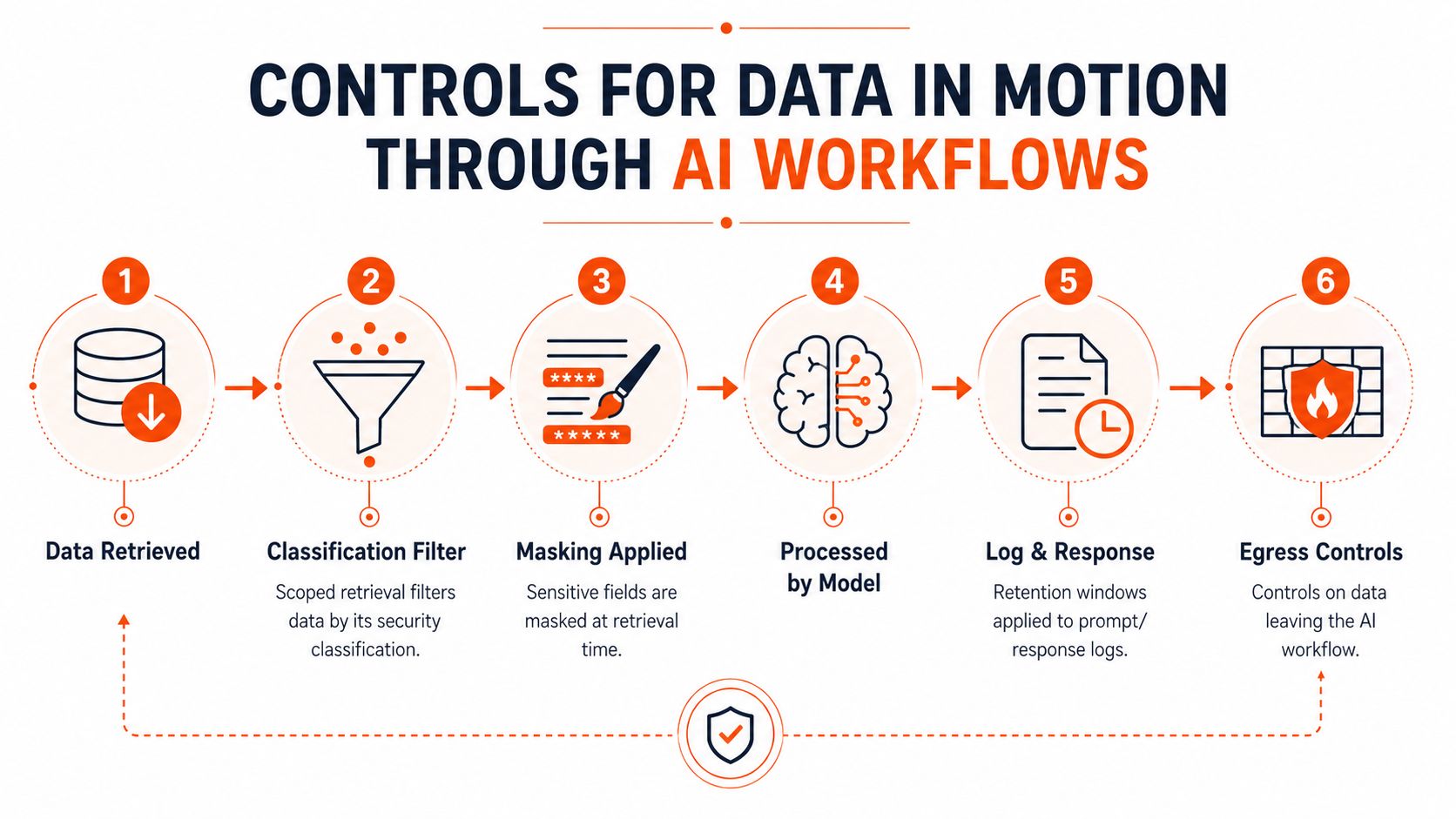
Controls that reduce risk
The practical rule set is straightforward:
- Mask at retrieval time. Sensitive fields should be redacted before they reach the prompt window.
- Filter by classification. Scoped retrieval needs to block restricted content from reaching copilots or training jobs.
- Set retention windows on logs. Prompt and response logs should not become a permanent shadow dataset.
- Bound outbound model calls. Egress controls should limit which model endpoints an agent can invoke.
- Revoke excess access. Overpermissioned service accounts need fast reduction in scope.
- Block unsafe ingestion. Training jobs that would ingest restricted data should fail closed.
That sequence creates a measurable cause-and-effect chain. When shadow AI tools and overpermissioned service accounts are found, unauthorized access drops because the reachable surface shrinks. When prompts and outputs are monitored, sensitive data exfiltration can be stopped before it leaves the organization. That is more useful than blanket advice about hardening AI, because it gives policy writers something enforceable.
What least privilege looks like in AI systems
Least privilege in AI extends beyond user roles to cover data paths and service identities. If a development model has standing access to production data, the review is incomplete. If an observability platform stores completions in full while the source system is tightly classified, the data controls are inconsistent. If a prompt logger ingests unredacted customer records, the organization has created a second copy of the problem in a looser control environment.
For a tighter view of the application-layer threat model around agents, see AI agent security risks. The important distinction is that the control still targets data movement, not just application behavior. Prompt and response monitoring matter because they expose the exact content that may be leaving the trust boundary.
Practical insight: a strong AI control policy usually has three verbs, mask, restrict, and revoke. If the policy only says “monitor,” it is not a control plan yet.
Prompt Injection and Indirect Prompt Injection as Data Risks
Prompt injection is not just a model trick. It is a data-path problem. When hostile instructions land in prompts, retrieved documents, or tool responses, they can steer the model into treating unsafe content as trusted context. Indirect prompt injection is worse because the malicious instruction can be hidden inside a document, webpage, or retrieved artifact that the system itself considered legitimate.
The control issue shows up fastest in prompt and context logs. Teams often classify databases carefully, then record full completions in observability systems that have broader access and longer retention than the original source. That is a silent reclassification downward. No one approved it. The workflow just did it. Microsoft's Purview DSPM for AI considerations explicitly ties risk calculation to detecting risky prompts and responses in Microsoft 365 Copilot, agents, and other generative AI apps Microsoft's DSPM for AI considerations. That is useful because it frames prompt and response telemetry as a governance signal, not just an app log.
Why this belongs in the data layer
SentinelOne's AI security posture guidance identifies prompt injection alongside model poisoning, data extraction, and adversarial examples as a named AI threat. Microsoft's guidance also calls prompt injection out directly, which makes it a first-class posture topic rather than a niche exploit class. The technical point is simple. If the prompt channel can be manipulated, the data layer is no longer passive. It is part of the attack path.
Controls need to reflect that reality:
- Prompt monitoring catches risky instructions and disclosures.
- Access restriction limits what retrieved context can enter the model.
- Response handling blocks sensitive data from being emitted or logged in unsafe places.
That approach matters more than treating prompt injection as a pure application-layer bug. The model may be the place where the bad decision becomes visible. The data layer is where the conditions for that decision were introduced.
Practical rule: if retrieval can import untrusted text, the retrieval path needs the same skepticism as any external input channel. The model doesn't get to decide which sources are safe by itself.
Drift Detection and Continuous Assurance on Every Commit
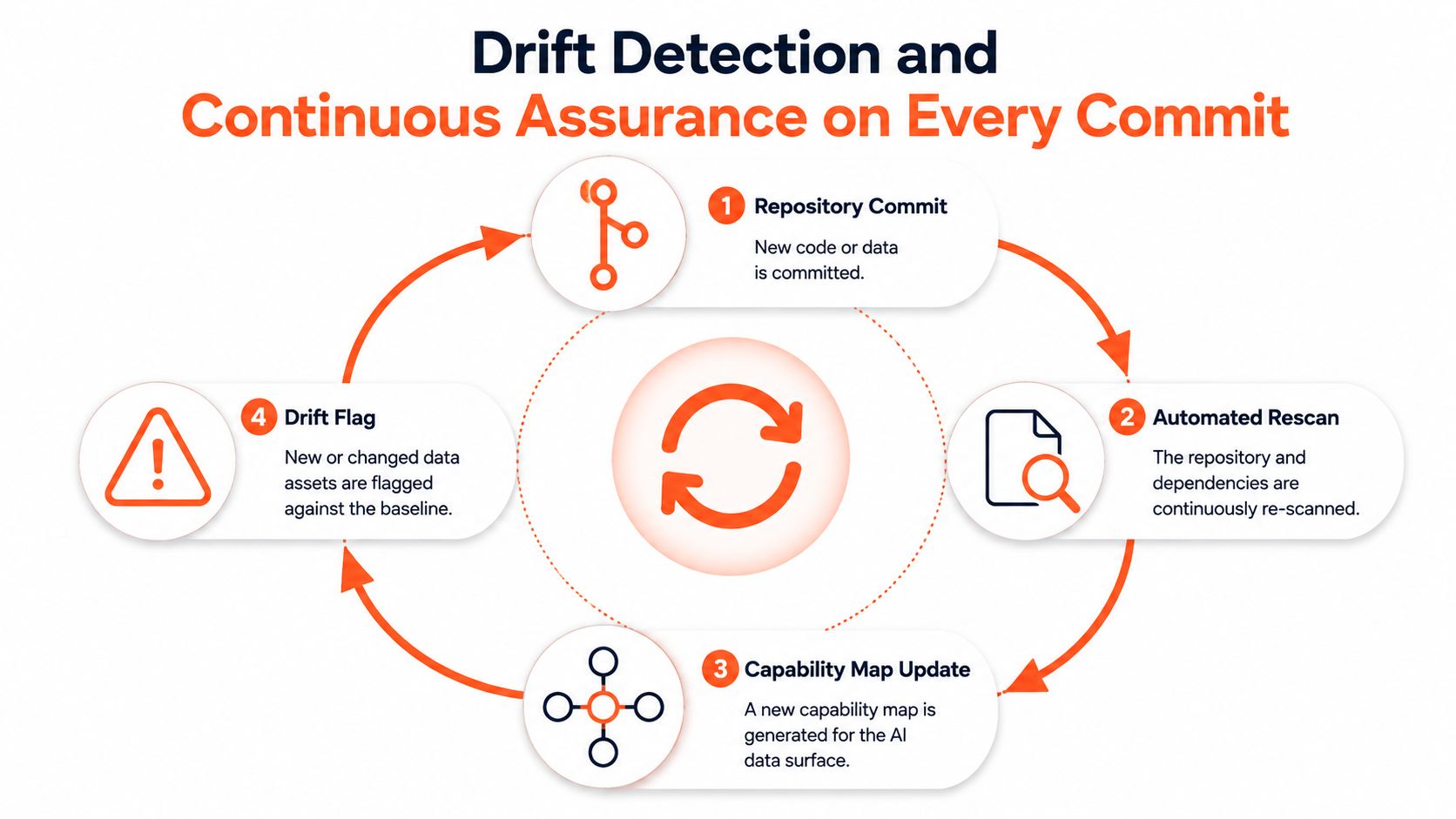
A repo can pick up a new tool binding, a vendor SDK, or a fresh data sink in a single pull request. That is enough to change the agent's exposure profile before anyone ships it. Periodic inventory misses those changes because the code has already moved on by the time the review lands.
Inside-out beats outside-in for pre-runtime assurance
Outside-in tools reveal what happened at runtime. Source-code reading reveals what is possible before it happens. That matters because many AI risks are capability risks, not event risks. If an agent can call a provider endpoint, access a dataset, or hand context to an internal tool, the exposure exists even if abuse has never shown up in logs.
The loop should stay simple and automatic.
- Repository commit. New code or dependencies land.
- Automated rescan. The repository and its dependencies are checked again.
- Capability map update. New paths, tools, and data reach appear on the map.
- Drift flag. Anything new or changed is compared with the baseline.
That cadence turns policy into a repeatable control. It also cuts time-to-inventory, because knowing what an agent touches stops being a manual exercise that drags across weeks and becomes something that runs on every commit. The metric that usually moves first is undeclared data paths per agent. Security teams cannot account for those paths before the first scan, then reduce them as credentials get scoped down and unused integrations are removed.
Controls that change exposure
Continuous assurance should produce three artifacts every time it runs.
- A capability map that lists reachable endpoints, stores, and credentials.
- A delta report that shows what changed since the last baseline.
- An evidence pack that ties each finding to file, line, and call path references.
Those artifacts let GRC track drift without waiting for a separate manual review. They also support a cleaner approval decision, because the team can approve, restrict, or decline an agent with recorded rationale. The result is less decision latency and fewer debates about whether a tool is probably safe. The answer is documented, or it is not.
For a quick way to estimate exposure before deeper review, see the agent risk calculator. It does not replace source review, but it gives teams a fast triage point when several owners need to sort an agent before it reaches runtime.
Mapping Capabilities to Controls and Audit Evidence
A capability map becomes useful when it lands on named controls. That is where technical findings turn into governance language. Agntz-style source mapping is especially helpful here because the evidence is attached to file, line, and call-path references instead of to generic runtime telemetry that arrives after the fact. A reviewer can see what the agent can reach, what it binds to, and which code paths justify the finding.
| Capability finding | Control family | Evidence artifact |
|---|---|---|
| Third-party model call path | ISO/IEC 42001, SOC 2, HIPAA | File, line, call path |
| Overpermissioned agent credential | ISO/IEC 27001, CMMC | File, line, dependency path |
| Sensitive data in prompt or response flow | NIST AI RMF, SOC 2, HIPAA | Prompt path, log reference, call path |
| Vendor transitive dependency with AI reach | ISO/IEC 42001, sector rules such as SR 11-7 and ITAR | Dependency chain, file reference |
That mapping is what shortens decision latency in AI adoption. Stakeholders can approve, restrict, or decline an agent with documented rationale because the finding is already tied to the control they care about. A CISO wants named control alignment. A VP R&D wants to know which capability is blocked. A GRC lead wants evidence that survives audit review.
The broader framework list matters too. ISO/IEC 42001, NIST AI RMF, ISO/IEC 27001, SOC 2, CMMC, HIPAA, SR 11-7, and ITAR all become easier to handle when the evidence is code-linked rather than observed after execution. That's especially valuable for teams evaluating multiple agents at once, because the same capability map can be reused across control families without redoing the analysis from scratch.
Audit-ready evidence is not a screenshot of an alert. It's a traceable chain from code to capability to control.
Frequently Asked Questions
What data path should a CISO lock down first in an AI assessment?
The first path to lock down is agent-to-third-party-model calls. That path often carries customer records, prompts, or context outside the perimeter. The right artifact is a capability map that shows which endpoints the agent can reach, which credentials it uses, and which data sources feed those calls.
How can teams continuously scan AI data flows without runtime sensors?
Use inside-out source scanning on every commit. Read the repository and its dependencies, generate a capability map, and compare it to the previous baseline. That catches new model endpoints, tool bindings, and vendor calls before runtime. It's more useful for posture work than waiting for traffic to prove something already escaped.
Which KPI moves first when DSPM for AI is implemented?
The first metric that usually changes is undeclared data paths per agent. Teams also see time-to-inventory shrink because capability maps are generated automatically instead of through manual interviews. Those two measures give engineering and GRC the same picture of what an agent can reach.
What's the most common unexpected vulnerability in AI data posture reviews?
The most common miss is prompt and context logs. Teams classify source data carefully, then log full completions in observability platforms with looser access controls. That creates a second copy of sensitive content in a weaker environment, which is a data reclassification problem as much as a logging problem.
Why is prompt injection a data security issue, not just an app bug?
Prompt injection changes the trust boundary of the data flowing into the model. Indirect prompt injection can hide malicious instructions inside retrieved documents or tool responses. DSPM for AI treats that as a data-layer problem because the control response has to cover retrieval, prompt monitoring, access restriction, and response handling together.
Agntz reads source code to build a capability map, an AI Bill of Materials, and blast-radius scoring before runtime. That gives security teams evidence-backed visibility into models, tools, data paths, and external services before an agent reaches production. Visit Agntz to run a free first scan and see which agent capabilities, data paths, and controls need attention first.
Own your AI risk
Estimate your exposure in under 3 minutes. No install, no access to grant.
Estimate Your Exposure