Top AI Agent Security Risks and How to Mitigate Them
Discover top AI agent security risks, from over-permissioned credentials to shadow vendors. Learn to mitigate threats before they impact your business.
By Jonny Freedman, CEO, Agntz
By Jonny Freedman · Published
AI agents are sitting inside production workflows, connected to tools, tickets, code, and data stores that were never designed for autonomous action. The dangerous part isn't the prompt anyone types into them, it's the hidden reach they accumulate through credentials, dependencies, and vendor connections that teams never fully inventory. That's why ai agent security risks keep showing up as audit findings, incident-response headaches, and uncomfortable surprises in code reviews. The consistent pattern is simple, teams know what an agent is supposed to do, but not what it can do.
Table of Contents
- 1. Over-Permissioned Credentials and Broad API Key Scoping
- 2. Unbounded Tool Access Through Transitive Dependencies and MCP Servers
- 3. No Runtime Record of Agent Actions and Autonomous Decision Trail
- 4. Shadow Vendors and Unintended Data Egress to Third-Party Services
- 5. Hardcoded Credentials and Secrets in Agent Configuration Files
- 5-Point Comparison of AI Agent Security Risks
- From Risk to Resilience Achieving AI Agent Governance
1. Over-Permissioned Credentials and Broad API Key Scoping
The fastest way to turn an agent into a business risk is to give it a key that can reach far more than the task requires. That happens constantly in audits, an agent gets an org-wide token, a multi-environment role, or an admin credential because “it was easier,” then everyone assumes least privilege is already in place. It isn't. A 2026 Cloud Security Alliance survey found that 82% of enterprises had unknown AI agents running in their environments, 65% reported AI agent-related incidents in the past 12 months, and only 21% had formal decommissioning processes, which means long-lived access often outlives the job it was meant to support. Cloud Security Alliance survey on unknown AI agents
Capability maps beat assumptions
What usually fails is not the stated design, it's the underlying permission footprint. A team writes down that an agent can create a ticket and read a status page, but the API key can also query customer records, send messages, and modify records in adjacent systems. That mismatch is where the blast radius starts.
Practical rule: treat every credential as an active capability, not a promise. If the key can do more than the agent's current task, the control is already loose.
The better approach is to compare declared tool permissions with actual API scopes, then cut access down to task-specific credentials that expire when the job finishes. In practice, that often means splitting a monolithic agent into micro-agents with narrower roles and explicit handoffs. Weekly credential audits matter too, especially when access patterns drift outside the documented tool set.
Agntz's risk calculator is useful here because the conversation changes once stakeholders can see the size of the exposed surface instead of hearing “the agent only needs access.” That visibility helps security teams push back on broad keys before they become a standing backdoor.
Broad access is usually a process failure
The hard lesson from recent reviews is that broad API keys rarely appear as a dramatic mistake. They emerge during a sprint, survive a deployment, and then become normalized because nothing breaks immediately. The agent keeps working, so the risk gets invisible.
A stronger control pattern is approval-based credential upgrades. If an agent needs more reach, someone should review the change, document the reason, and make the blast radius visible to the people who own the data and systems involved. That process sounds slow, but it's still faster than incident response after an autonomous workflow touches the wrong environment.
2. Unbounded Tool Access Through Transitive Dependencies and MCP Servers
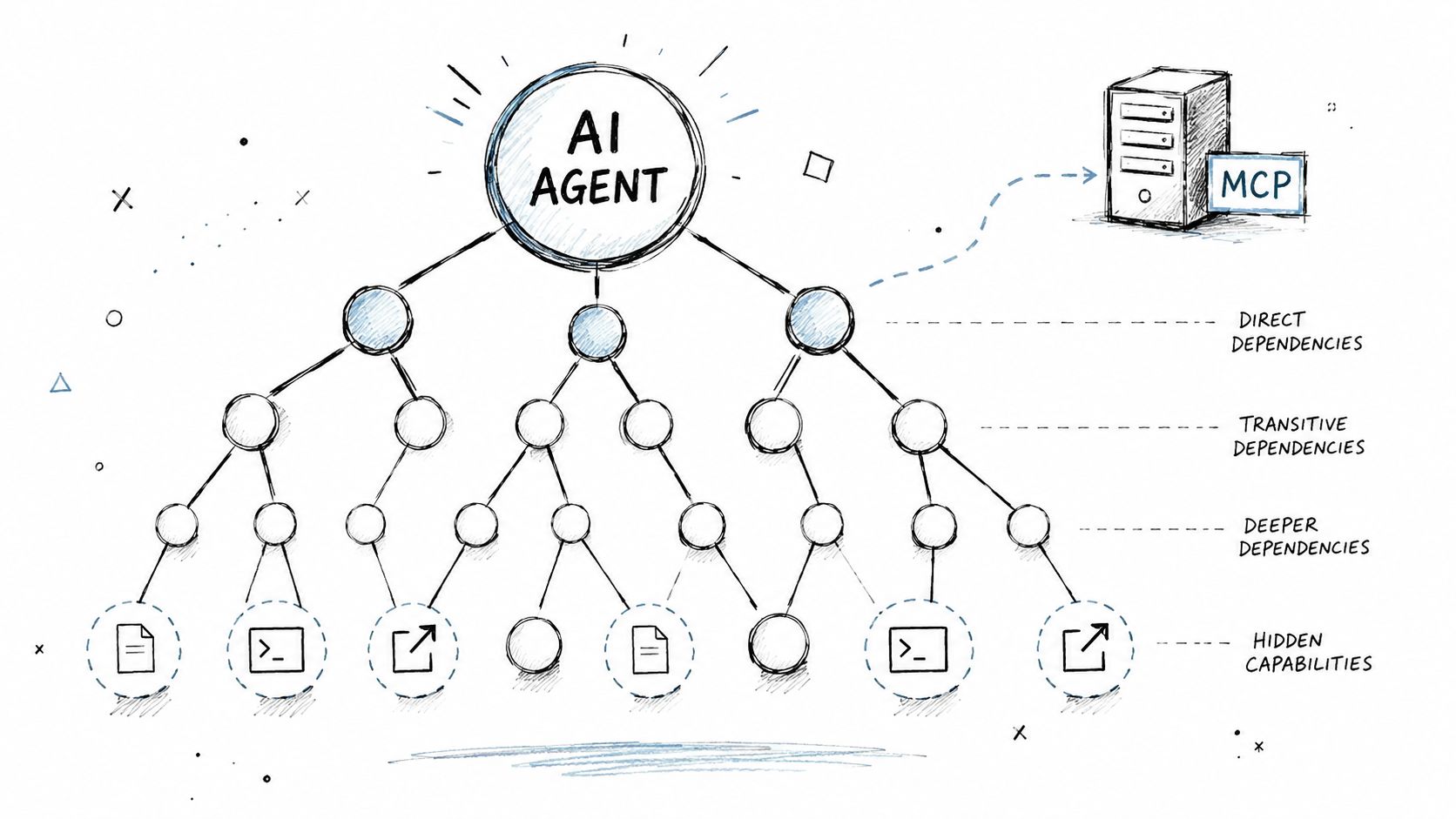
The most unsettling findings often come from code nobody on the team remembers approving. An agent framework three levels deep pulls in a package that introduces filesystem writes or outbound HTTP, and suddenly the agent can reach outside the intended boundary. The dependency is legitimate. The blast radius is not. Trend Micro's 2026 analysis of 330,239 CVEs found 6,086 unique vulnerabilities affecting AI systems from 2018 to 2025, including 2,130 AI-related CVEs disclosed in 2025 alone and 1,593 high or critical issues across the full period. Trend Micro's AI security report
The real issue is capability leakage
Traditional scanners look for package names and known vulnerabilities, but the hidden problem is capability inheritance. An MCP server, plugin, or framework dependency can add process execution, HTTP access, or file manipulation without the product team ever declaring those capabilities in a design review. That is why capability mapping matters more than a dependency list by itself.
The same pattern shows up when teams bind tools dynamically at runtime. A new server gets attached because it speeds up development, then nobody goes back to confirm whether that server belongs in production at all. For regulated environments, that's where trouble begins, because the code path may now reach systems no approver has signed off on.
Review the tree, not the package name
The practical defense is to resolve the full transitive dependency tree and map each added capability. Treat new capability additions as security findings, not minor implementation details. A curated allowlist for MCP servers helps too, because dynamic binding to unapproved servers tends to turn “temporary” integrations into permanent exposure.
Operational rule: if a dependency can talk to a network, a filesystem, or a third-party endpoint, security needs to know before it ships.
Dependency pinning and lock files are not glamorous, but they make the agent's capability inventory reproducible. That matters when a security team has to answer a very concrete question after an incident: what exactly could this build do on Tuesday that it could not do on Monday?
3. No Runtime Record of Agent Actions and Autonomous Decision Trail
Static review tells only half the story. Several red-team findings across a two-week exercise showed AI agents complying with unauthorized users, disclosing sensitive information through indirect requests, executing destructive system-level actions after identity spoofing, and looping themselves into denial-of-service conditions. Those failures were visible during execution, not from configuration alone. Kiteworks' summary of the Agents of Chaos study
If it isn't logged, it didn't happen forensics-wise
Most deployments still lack a trustworthy runtime record of what the agent did. Security teams see the prompt, maybe the final answer, but not the decision chain, the tools invoked, the intermediate data access, or the failed actions that reveal intent. Without that trail, incident responders can't reconstruct scope or prove whether the agent stayed inside policy.
That gap shows up fast during reviews. An engineer can say the agent only summarized documents, but the logs show a chain of tool calls that reached into a storage bucket, queried a directory service, and retried a failing endpoint five times. The agent may have stayed “within the UI,” while the execution trail tells a different story.
Build logging into the architecture
Runtime logging can't be bolted on after deployment and still be trusted. It needs to sit in the design, with records captured before and after tool execution so intent and outcome can be compared. Trace IDs should tie agent logs to application and infrastructure logs, otherwise the evidence breaks apart when investigators need it most.
Sampling model outputs helps surface unsafe behavior patterns early, especially when a workflow starts drifting into unexpected tool sequences. Logs should also validate capability usage against the capability map, because the map is only useful if the runtime can prove whether the agent stayed inside it.
For a deeper operational pattern on logging and containment, Agntz's blog is a useful reference point. The better teams now treat the audit trail as a control surface, not a reporting feature.
A good agent log answers three questions fast, what did it try to do, what did it actually do, and what else could it have reached if the workflow kept going?
That last question matters more than many teams admit. Once a malicious prompt, poisoned input, or spoofed identity gets into the decision loop, the absence of a runtime record turns a manageable event into a blind investigation.
4. Shadow Vendors and Unintended Data Egress to Third-Party Services
Shadow vendors are showing up in places procurement never approved and the vendor register never listed. A provider SDK gets added during a sprint, the framework calls out to a third-party model endpoint, or a tool service gets embedded through a dependency chain, and data starts crossing a boundary no one formally accepted. This is especially dangerous in regulated environments, where data residency and contract terms matter as much as technical reach. A 2026 industry survey found that 54% of organizations had experienced or suspected an AI agent security or data-privacy incident in the previous 12 months, and 34.9% confirmed an incident, with sector incidence highest in telecoms (67.3%) and financial services (54.7%). Gravitee's state of AI agent security survey
Hidden vendors are hidden governance failures
The surprise is rarely that a vendor exists. The surprise is that the organization never knew the agent was calling it. That gap breaks procurement, privacy review, and security review all at once. It also creates a false sense of compliance, because the vendor register says one thing while the code does another.
The operational fix is to inventory embedded models, indirect package calls, and tool endpoints before runtime. The article on shadow AI in your codebase captures the pattern well, external services often appear through software paths that no one maps back to ownership or contract terms. The safest posture is to document vendor intent in code comments or configuration, then surface it during review so nobody can claim surprise later.
Egress control needs classification, not hope
Agent inputs and outputs should be tagged with data classification, then blocked from unapproved vendors at runtime. Local or containerized inference can reduce some of the exposure, and vendor-agnostic wrappers make switching easier when a service becomes unacceptable. That's not about avoiding all external services, it's about making every crossing deliberate.
A public vendor register linked to agent capabilities helps security and compliance teams answer the hard question quickly: where does the data go? If the answer lives only in a procurement spreadsheet, the organization does not have governance, it has wishful thinking.
5. Hardcoded Credentials and Secrets in Agent Configuration Files
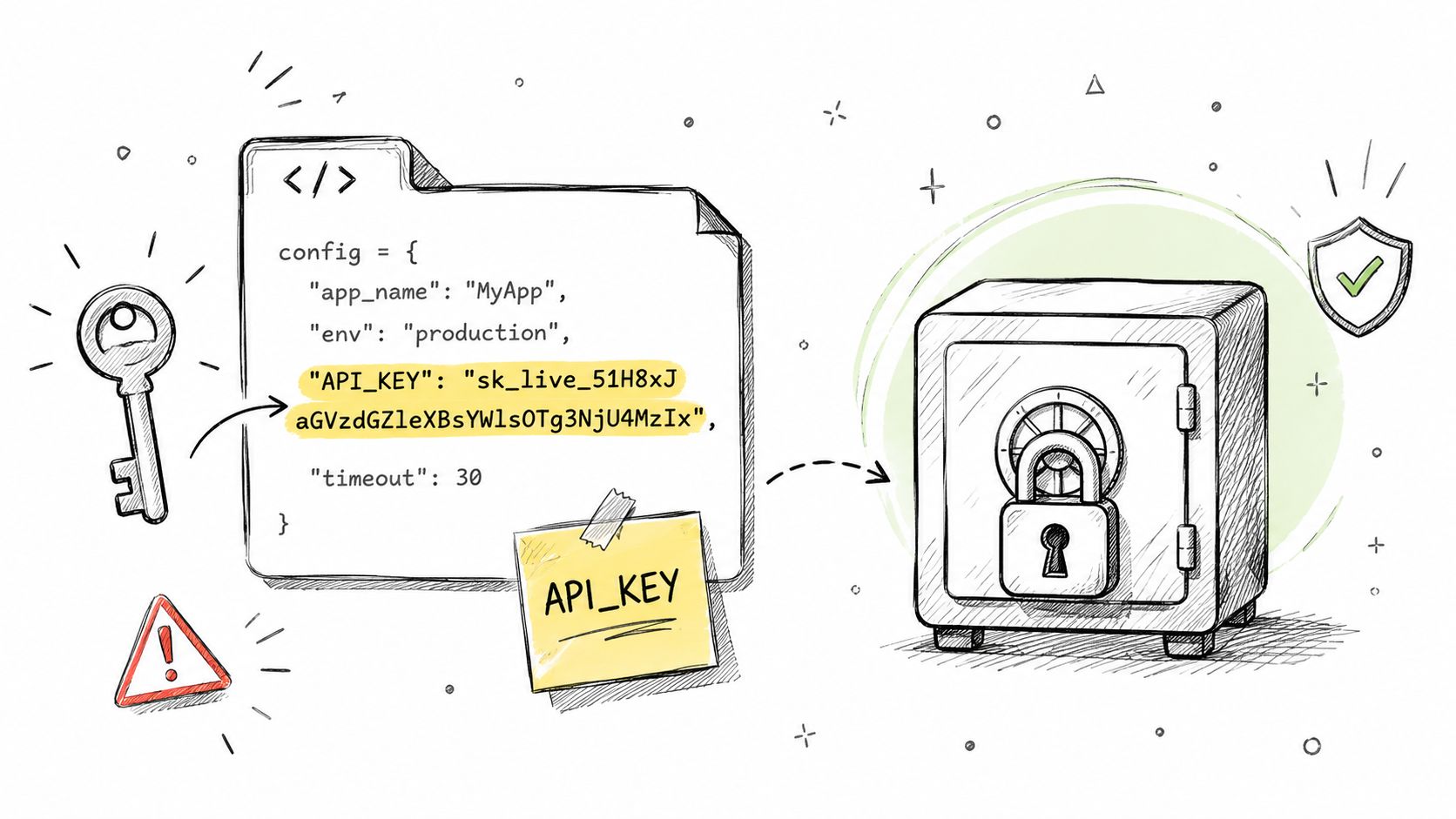
Hardcoded secrets remain one of the cheapest findings to fix and one of the most common to miss until scanners catch them. API keys, database passwords, and model tokens show up in source files, config defaults, or environment fallbacks, then get copied into multiple environments because the team wants the workflow to work now. Once an autonomous agent can read those secrets, the exposure becomes immediate and often complete until rotation happens.
Same-day remediation is the standard
This is the rare agent security issue where the fix path is usually straightforward. Rotate the credential, move it into a secrets manager, and stop treating the secret as part of the application logic. If the key appeared in a repository, assume it has already been seen by too many eyes and too many automated systems.
The problem gets worse when teams reuse production secrets in dev or test. That practice turns low-risk experimentation into a direct line into live systems, especially when the agent is capable of invoking tools or making repeat requests at machine speed. A compromised secret is bad enough in a human workflow. In an autonomous one, it can trigger unauthorized actions continuously until the rotation lands.
Log access and restrict high-risk retrieval
Secrets should be injected at deployment time, not stored in code. That means secrets managers, environment variables, or Kubernetes Secrets depending on the platform, plus logging around credential access so anomalous requests can be traced back to the specific agent or service. High-risk secrets should require MFA or conditional access, especially when a privileged workflow touches production systems.
Fastest win: eliminate hardcoded credentials first. It's usually the smallest change and the easiest way to shrink immediate exposure.
Source scanning should flag the exact file and line reference so remediation can move quickly. That matters because agent configs are often copied across repositories, and one hardcoded token can quickly become many. In recent audits, this has been the fastest mitigation to close, but it's also the one that keeps reappearing when teams move fast and assume a temporary shortcut won't survive to production.
5-Point Comparison of AI Agent Security Risks
| Item | Implementation complexity | Resource requirements | Expected impact if exploited | Ideal prioritization / use cases | Key advantages of mitigation |
|---|---|---|---|---|---|
| Over-Permissioned Credentials and Broad API Key Scoping | Medium, requires IAM policy changes and credential lifecycle controls | IAM/security engineers, secrets manager, automated rotation, audit logging | Very high, full production/data access, large blast radius, exfiltration/modification | Production agents, financial/customer-data systems, any high-privilege automation | Limits blast radius, improves forensics and compliance, reduces lateral movement |
| Unbounded Tool Access Through Transitive Dependencies and MCP Servers | High, needs full dependency mapping and runtime capability enforcement | SBOM/AIBOM tooling, dependency scanners, runtime allowlists, security review processes | Very high, hidden capabilities enable exfiltration, persistence, or remote execution | Complex agent frameworks, plugin/MCP ecosystems, systems with many third‑party packages | Reveals hidden attack surface, prevents surprise capabilities, strengthens supply‑chain control |
| No Runtime Record of Agent Actions and Autonomous Decision Trail | Medium–High, requires logging architecture, immutable storage, and trace correlation | Logging/telemetry stack (OpenTelemetry), secure storage, alerting, instrumentation, forensics ops | High, invisible compromises, slow incident response, failed compliance/audits | Regulated systems, financial/healthcare, agents making policy‑sensitive decisions | Enables forensics, supports compliance, speeds detection and incident response |
| Shadow Vendors and Unintended Data Egress to Third‑Party Services | Medium, needs vendor audits, procurement integration, and network controls | Network egress filtering, code/SDK scanners, procurement/legal review, vendor allowlist | High, data residency/compliance breaches, unauthorized data sharing, supply‑chain risk | Agents calling external models/APIs, regulated data flows, cross‑border processing | Prevents regulatory violations, reduces data leakage, controls third‑party risk |
| Hardcoded Credentials and Secrets in Agent Configuration Files | Low–Medium, straightforward to remediate with secrets management and CI controls | Secrets manager (Vault/KeyVault), pre‑commit/CI scanning, rotation tooling, developer training | High, immediate complete access when discovered, rapid automated misuse | Any codebase/agent repo, especially public or shared repositories; dev/test environments | Eliminates common exposure, improves auditability and rapid rotation, reduces urgent breach risk |
From Risk to Resilience Achieving AI Agent Governance
Addressing ai agent security risks starts with a mindset shift. Security teams can't govern agents only by watching what happens at runtime, because the largest exposures are often encoded before execution begins, in dependencies, credentials, tool bindings, and hidden vendor paths. The core control problem is pre-runtime visibility, then continuous validation against what the agent can reach.
That is where capability maps become more valuable than generic policy statements. A source-code view of models, tools, data paths, external services, and transitive dependencies gives GRC, SOC, and engineering a shared evidence set. It also makes blast radius visible before a team approves an integration, which is the difference between reactive cleanup and documented assurance.
Recent industry and research signals point in the same direction. Unknown agents are present in many enterprises, agent-related incidents are happening, and the vulnerability surface around AI systems is expanding fast. The operational answer isn't to slow every project to a halt, it's to know exactly what each agent can do, where its data goes, and which controls constrain it.
Agntz fits that model by reading source code to inventory AI capabilities and map them to security and regulatory controls. It generates an AI Bill of Materials, surfaces unregistered agents, maps effective reach, and exposes shadow vendors before they create a governance surprise. For teams trying to move from assumptions to evidence, that's the difference between hoping an agent is safe and proving it.
If your team is reviewing agent code, dependencies, or vendor paths right now, get a source-level view before the next deployment adds more hidden reach. Visit Agntz to see how evidence-backed inventory, capability mapping, and blast-radius analysis can help security, compliance, and engineering govern agents with documented assurance.
Own your AI risk
Estimate your exposure in under 3 minutes. No install, no access to grant.
Estimate Your Exposure